

To Migrate Is a Fundamental Human Right — and a Movement of Resistance
Thursday, 18 December 2025
International Migrants Day arrives amid an unprecedented escalation of forced displacement and systematic attacks on migrants, refugees, and their fundamental rights. Across regions, states are expanding border fortification, detention regimes, deportation machinery, and the criminalisation of solidarity, using global crises as justification.
These conditions cannot be separated from the violence of global capitalism and imperialism, which today manifest through wars and military occupations, genocide and ethnic cleansing—most visibly in Palestine—alongside climate breakdown, land dispossession, economic extraction, and widespread hunger. These forces uproot entire communities, destroy livelihoods, and compel millions into survival migration. This global landscape forms the backdrop against which migrant organisations, grassroots movements, and solidarity networks shared their experiences and analyses during the 13 December gathering.
Sharings from the 13 December Movement Exchange
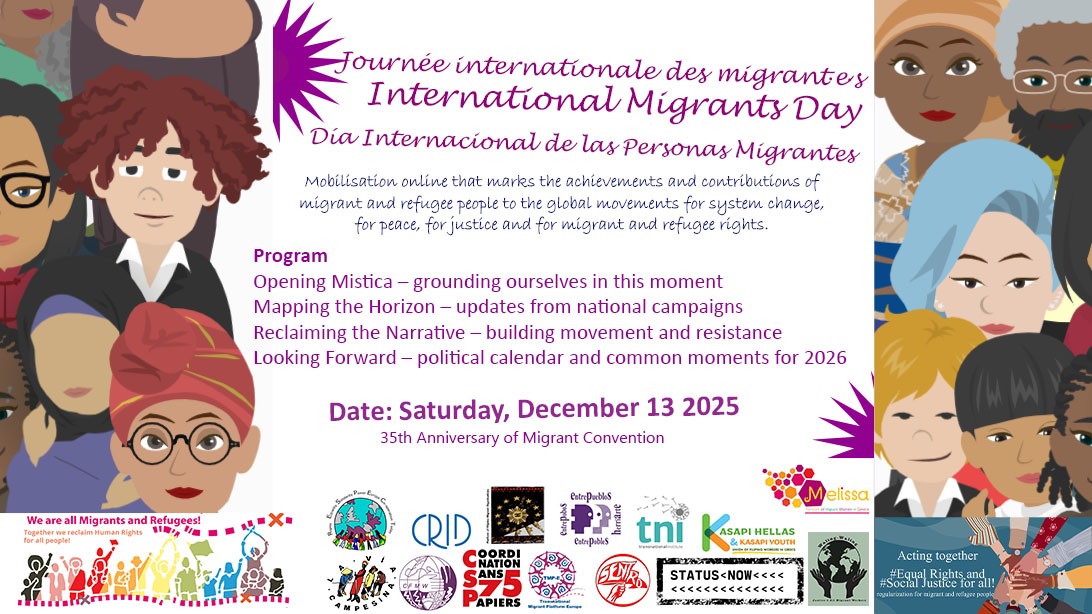
The 13 December gathering brought together migrant organisations, trade unions, women’s collectives, peasant movements, and solidarity networks from across the world. Their interventions underscored how deeply interconnected our struggles are.
Speakers from La Via Campesina reminded us that migration cannot be separated from land grabs, climate breakdown, corporate control, and the dismantling of rural livelihoods. Peasant, Indigenous, and workers’ movements at the 3rd Nyeleni Global Forum (Kandy Declaration) reaffirmed that migrant justice is inseparable from food sovereignty, climate justice, feminist struggles, and the fight against racism and patriarchy.
From Morocco and the broader Maghreb, comrades highlighted how climate change, collapsing rural incomes, and agro-business extractivism push communities into forced migration—only to face institutional violence, exploitation, and deadly border regimes fueled by EU externalisation policies.
From the Philippines, Malaysia, Bangladesh, and other regions, workers shared how poverty wages, recruitment debt, and the absence of social protection force people into circular and precarious migration. Women domestic workers described organising across borders despite exclusion from local labour movements, demanding recognition, rights, and dignity.
European sharings—from the Netherlands, UK, France, Ireland, Greece, and Switzerland—detailed the rise of fascist narratives, labour precarity, the criminalisation of undocumented people, assaults on gender justice, and the entrenchment of the EU Pact on Migration and Asylum. Speakers exposed a political climate where hatred is normalised, violence is bureaucratised, and migrants are scapegoated for crises produced by states and corporations. Yet they also shared stories of resistance: legal victories won by domestic workers, student occupations in solidarity with Palestine, strikes and demonstrations pushing back against hostile environment policies, and cultural organising that reclaims migrants’ narratives and humanity.
The Permanent Peoples’ Tribunal reminded us that the violence confronting migrants is not incidental but systemic — the result of a global order that dehumanises and expels those it exploits. The Tribunal affirmed that our struggles are not isolated; they converge in a fight for the rights of peoples everywhere.
Together, these sharings made one truth unmistakably clear: migrants are not the crisis — the system is. And only through collective struggle can that system be transformed.
Migrant Movements Organise and Build Resistance
Despite the structural violence confronting them, migrant and refugee peoples continue to organise, resist, and build collective power. Migrant workers sustain societies economically, politically, and culturally, while their remittances support families and communities and prop up national economies—often channelled into servicing debts imposed through global inequalities.
Across continents, migrant and refugee organisations refuse criminalisation and xenophobia and continue building movements rooted in dignity, justice, and system change. At the 13 December gathering, organisations collectively affirmed their commitment to:
- Advance the campaign for regularisation for all, unconditional and immediate.
- Shift public narratives by naming the political, economic, and cultural contributions of migrant and refugee peoples and reclaiming the truth of migration as a force of life and resistance. See the clip in English, French and Spanish.
- Affirm that human history is a history of migration, and that migration has always been a response to and defiance of injustice, exploitation, colonialism, capitalism, and imperialism.
- Strengthen the Global Pact of Solidarity, our collective response to a global system that dehumanises, dispossesses, and destroys—and build instead a world grounded in justice, dignity, and peace for all peoples.